
How to Clean and Care for Your Baby's Pacifier Clip: The Complete Hygiene Guide
It goes from your baby's mouth to the floor, from the floor to the stroller, from the stroller to your pocket… and then right back into your baby's mouth. The pacifier clip is probably the most handled baby accessory of the day, yet we often forget to clean it as regularly as the pacifier itself. A few simple habits are all it takes to protect your little one's hygiene and make this everyday essential last. Here's our complete guide to cleaning and caring for your baby's pacifier clip, material by material, safely and without the fuss.
Why caring for the pacifier clip really matters
The pacifier clip does a very handy job: it stops the pacifier from falling on the floor and getting lost. But because it ends up trailing just about everywhere, it collects saliva, dust, crumbs and fingerprints. Since it's in constant, indirect contact with your baby's mouth, keeping it clean is simply part of good everyday hygiene, just like washing hands or cleaning teething toys.
Regular care has another very practical benefit too: it extends the life of the accessory. The clip, cord and beads wear out more slowly when they're cleaned gently rather than left to dry with crusted saliva or scrubbed harshly. Well looked after, a quality pacifier clip can stay with your baby for many months, and may even be passed down to a little brother or sister.
First step: identify the material
There isn't a single right way to clean a pacifier clip, but several, depending on what yours is made of. Before you start, check the material, because the same action that's fine for silicone can damage fabric or wood. There are three main families:
- Food-grade silicone: smooth or textured beads, very common and loved for being hygienic and easy to wipe down. Discover our range of silicone pacifier clips.
- Fabric, often cotton gauze: soft, light and pretty, it calls for slightly more delicate washing. Browse our designs in the fabric pacifier clip collection.
- Wood: found on some clips or decorative beads, this is the material most sensitive to water.
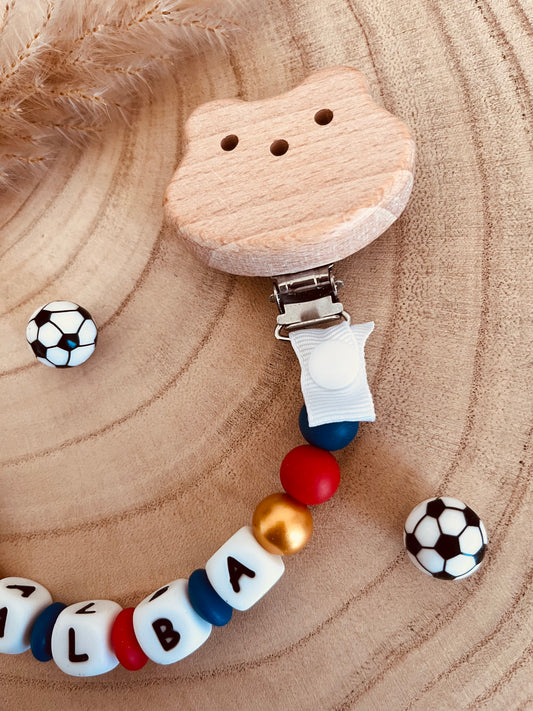
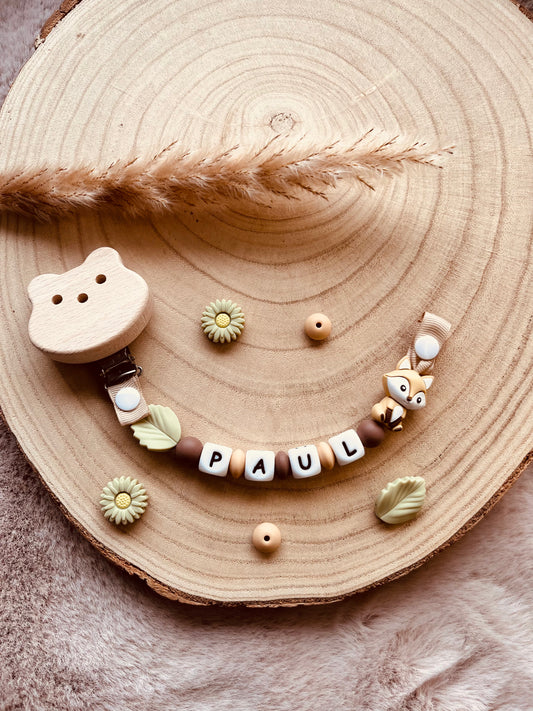
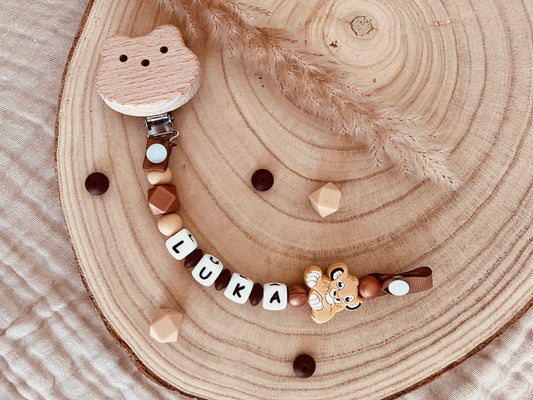
Many pacifier clips combine several materials, for example silicone beads paired with a wooden ring or clip. In that case, always adapt your method to the most delicate material, which here is the wood.
How to clean a silicone pacifier clip
Food-grade silicone is probably the easiest material to care for, which largely explains its popularity. Its smooth, non-porous surface doesn't hold onto dirt and cleans up in seconds.
Day to day, a quick wipe with a clean, slightly damp cloth is enough to remove saliva and dust. Once or twice a week, or whenever the clip looks visibly dirty, give it a more thorough clean: use warm water and a little mild soap (natural soap, gentle dish soap or a special baby-care soap), gently rubbing the beads with your fingertips. Then rinse thoroughly with clean water so no soap residue is left behind, and dry with a clean cloth or let it air dry.
When it comes to sterilizing in boiling water or a sterilizer, opinions differ from one brand to another. Silicone generally holds up well, but the clip's other parts (the cord, the clasp, decorative elements) don't always cope with heat or prolonged soaking. The golden rule: always follow the manufacturer's care instructions. When in doubt, cleaning with warm soapy water remains the safest option for the accessory as a whole.
How to clean a fabric or cotton gauze pacifier clip
Fabric designs, and cotton gauze ones in particular, win parents over with their softness and good looks. In return, the material absorbs moisture and holds onto marks more easily, which calls for a little more care.
For a quick spot clean, dab the affected area with a damp cloth and a touch of mild soap, without soaking the fabric. For a more thorough clean, hand washing in warm water is ideal: it's kind to the fibers and to any assembled parts. If the label or product page allows it, a low-temperature machine wash (30 °C, delicate cycle) inside a wash bag is possible, but it's best to check first, since the clip and cord don't always enjoy the drum.
Skip the tumble dryer, which can warp the fabric and weaken the seams: go for flat, air drying, away from any direct heat source. Make sure the clip is completely dry before giving it back to your baby, as a still-damp material can lead to unpleasant smells. Our fabric pacifier clips are made for everyday use, but they'll thank you for a little gentleness at wash time.
What about the wooden parts?
Wood is a natural, living material that hates being drenched. Never soak it in water and never put it in the dishwasher, the sterilizer or the washing machine. Simply wipe the wooden beads or clip with a barely damp cloth, then dry them straight away. Prolonged soaking would cause the wood to swell, dull its finish and could lead to tiny cracks over time.
How often should you clean the pacifier clip?
There's no one-size-fits-all schedule: it all depends on use. A good rule of thumb is a quick wipe every day and a more thorough clean once or twice a week. Some situations do call for immediate cleaning, though: after a drop on the floor or outdoors, if it comes into contact with food, during a cold or a stomach bug, or simply whenever the clip looks dirty. A regular, light touch beats a rare, harsh deep clean.
Mistakes to avoid
A few habits, often well-meaning, can actually damage the pacifier clip or compromise its hygiene:
- Cleaning with very hot or boiling water without checking first: heat can warp certain parts and weaken the cord.
- Using bleach or harsh household products: they have no place on an accessory that goes near the mouth. Always choose a mild soap.
- Leaving the clip damp before storing it or handing it back to your baby, which encourages smells and trapped moisture.
- Scrubbing the beads hard or tugging on the cord to "lift off" dirt, at the risk of stretching the assembly.
- Putting a wooden or fabric design in the dishwasher, unless the manufacturer explicitly says so.
Good care means safety too
Cleaning the pacifier clip regularly is also a chance to inspect it. Use each wash to check its overall condition: does the clip open and close properly? Is the cord still securely attached? Are the beads firmly held, with no play or cracks? A damaged clip should be replaced without hesitation.
As for regulations, in Europe pacifier clips must meet the NF EN 12586 standard, which sets out precise safety requirements. Among other things, it requires that the length of the clip, measured without the pacifier or the clasp, must not exceed 220 mm; and if the clip forms a loop, that length is limited to 110 mm. These rules are designed to reduce the risk of the cord wrapping around the child's neck. Keep the common-sense guidelines in mind too: never lengthen the cord, never leave your baby unsupervised with the clip, and don't use it in the crib during sleep.
An easy-going clip, right from the start
Stress-free care starts with a good choice at the time of purchase. By going for quality materials that are easy to clean, you make everyday life simpler. Food-grade silicone, for instance, is hard to beat for convenience: our silicone pacifier clips wipe clean in the blink of an eye and keep looking great wash after wash. For those who prefer the softness and charm of textile, our fabric pacifier clips add a tender touch to your baby's outfit, with care that's entirely manageable as long as you follow a few precautions.
Personalized with your child's name, the pacifier clip also becomes a little one-of-a-kind keepsake you grow attached to. All the more reason to look after it: a few seconds of cleaning each day are enough to keep it looking spotless, day after day.
In summary
Caring for your baby's pacifier clip is nothing complicated: first identify the material, clean silicone with warm soapy water, wash fabric with plenty of care, simply wipe wood without soaking it, and always dry the accessory thoroughly before handing it back to your baby. A quick daily touch-up, a more thorough clean once or twice a week, and a little safety check at each wash: that's the ideal routine for a pacifier clip that's clean, long-lasting and safe. So you can enjoy this handy, adorable accessory with complete peace of mind.