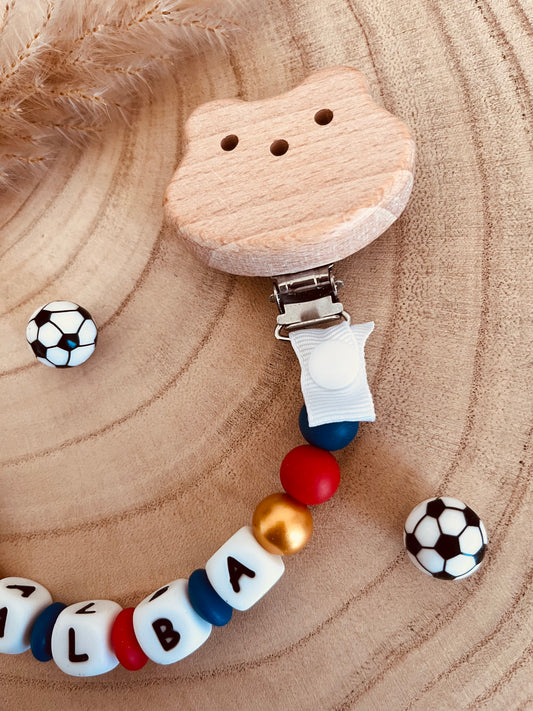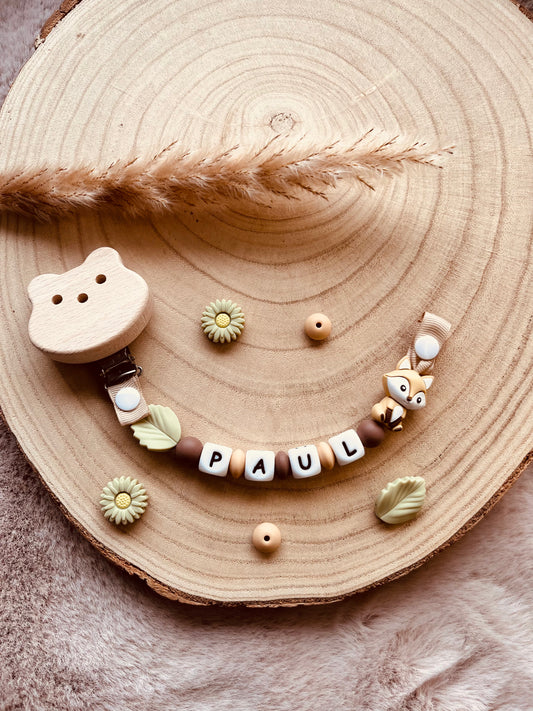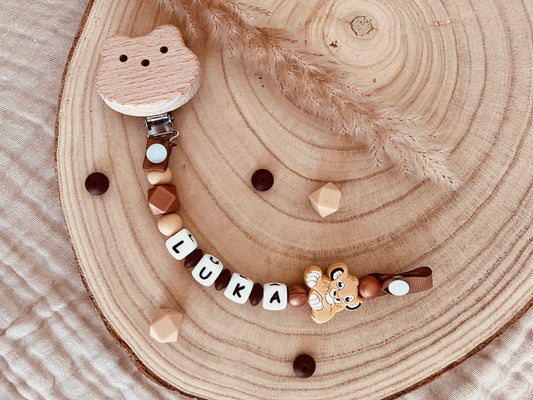

The different materials used in dummy clips
Everything you need to know about dummy clips
Essential for parents' peace of mind and reassuring for babies, meet the family's must-have accessory.
Babies show a taste for sucking right from birth — in fact, a dummy is used by 80% of children under the age of 3.
To stop your child losing their dummy, a dummy clip is just the accessory they need.
Here are a few tips to bear in mind before fitting your child with a dummy clip:
A dummy clip must not be longer than 22 cm.
When you put your child to bed, remove the dummy clip to avoid any accident.
If you notice any wear, stop using the dummy clip.
In general, dummy clips come with a fastening system. You'll find non-slip clips, press studs or even metal fasteners.
There are all sorts of dummy clip designs to delight your little one and go along with them on every adventure.
Nursery products: the standards in France
There are certain safety measures to bear in mind to avoid any kind of problem. Chewing and sucking can sometimes cause difficulties, as harmful substances may be swallowed by your child without anyone realising. This is why the NF EN71-3 standard, which governs the chemical components found in the materials used to make toys and other baby items, was published by the CEN/TC 52 Technical Committee in 2013. This standard ensures the manufacturer guarantees the reliability of its product — and that's exactly what we apply in our own process.
Other standards have been introduced to give parents and babies even greater peace of mind, such as DIN 53160-1/-2. This standard tests objects for colour retention, among other things — an important test for the product's durability that helps avoid any risks linked to your baby's saliva or sweat.
Dummy clip materials
Dummy clips are made from several materials, giving an endless range to suit your baby's tastes and needs. The most commonly used material for the clip itself is metal, prized for its durability despite the rust that can set in. Another sturdy material that doesn't rust is stainless steel.
As for the cord of the dummy clip, cotton, wood, silicone, nylon and even leather are among the materials used.
The vintage, authentic look of wood isn't its only advantage. Its sturdiness is a real selling point too, given how much our little ones love to chew and throw their toys. Wood is a healthy ally, as it isn't harmful to children provided it's good quality. Wooden toys and accessories are also kind to the environment. This fine material gives toys and accessories a longer life than their plastic counterparts.
Just like wood, fabric is one of the most hard-wearing materials. Fabric toys and accessories don't break — they simply wear out more slowly.
The safety and health of our children are two things at the very heart of our concerns. Choosing materials that are barely processed, or not at all, is a mark of quality and safety.
Natural materials can also have undergone chemical treatments, so keep an eye on varnishes and paints, as well as the glue used, as these chemicals can be harmful.
Some materials should be avoided at all costs, such as aluminium and zinc!
Materials that are kind to the environment
Several materials, then, go into making a dummy clip. Wood, however, is the most sustainable of them all. The PEFC (Programme for the Endorsement of Forest Certification) and FSC (Forest Stewardship Council) labels confirm that a material supports sustainable development and respects the environment.
Indeed, when making a dummy clip, the PEFC label calls for the non-use of potentially toxic products, in particular insecticides — a criterion that helps keep your baby safe.
And that's not all! All our products are Made in France as well as being kind to the environment.
How the dummy clip will become your favourite thing
As a parent, we've all spent hours on end hunting for baby's dummy — and that's exactly why the dummy clip will become your best friend! For its practicality, of course, but also for its good looks, not to mention its safety and hygiene benefits (no more picking up a dummy that's fallen on the pavement covered in germs).
But there's another advantage some people don't spot at first: it can double as a teether, so your baby can chew away to help their teeth come through, with no risk thanks to the standards that have been applied.
When making a dummy clip, the PEFC label calls for the non-use of potentially toxic products, in particular insecticides — a criterion that helps keep your baby safe.
And that's not all! All our products are Made in France as well as being kind to the environment.
Ready to take the plunge? Discover our personalised dummy clips with baby's name — carefully made, EN 12586 standard, shipped within 48 h.