
When to give baby a dummy — and when to stop?
On the maternity ward, a young mum watches her two-day-old baby drift off to sleep on her chest, tiny and new, and quietly asks the question so many parents ask before her: "Am I allowed to give him a dummy, right now?" The midwife smiles, because she hears it ten times a week. The truth is, there's no one-word answer. The dummy, and the dummy clip that goes with it, each has its right moment to arrive in your baby's life… and its right moment to bow out.
Let's take it step by step, with no dogma and no guilt: when to offer a dummy, when a dummy clip actually earns its place, what the safety rules say, and how long this whole little world can stick around.
From birth, or is it better to wait a little?
It depends first on how your baby is fed. If you're breastfeeding, the most common advice is to wait until feeding is well established before introducing a dummy, often around three to four weeks in. The reason is simple: latching at the breast and sucking on a dummy don't call for exactly the same mouth movement, and offering both too soon can, in some babies, blur the signals while breastfeeding finds its rhythm. Nothing set in stone, but it's wise to let feeds settle first.
If your baby is bottle-fed, that precaution doesn't apply in quite the same way, and a dummy can be offered earlier if the urge to suck is clearly there. Because that's really what this is about: sucking isn't only about hunger. It's a wonderful self-soothing reflex, a way for a tiny person to reassure themselves, to settle, sometimes to drift off to sleep. Some babies need it enormously, others barely at all — and both are perfectly normal.
So no, there's no rush to reach for the dummy on day one at the hospital. But there's no black mark against you either if you do. Watch your baby: they're the ones who'll really tell you whether they want it or not.
The dummy clip: the little accessory that changes your days out
The dummy is one thing. The dummy clip is quite another, and it comes into play a little later — usually once your baby starts to wriggle and grab, and above all once the real days out begin. Because a dummy falls. It falls under the café table, it falls between the floorboards, it falls in the supermarket aisle at exactly the moment both your hands are full. By the tenth time, the point of that little clip holding it to the clothes becomes very clear indeed.
In practice, a dummy clip earns its keep from the very first weeks of walks and pram trips: it keeps the dummy clean and within reach, it heads off the meltdowns when it rolls under the buggy, and it saves you carting three spare dummies around in the changing bag. To get started, a dummy clip made for your first outings is plenty: light, easy to clip on, nice to chew on when those first teeth start pushing through.
As for the material, it really comes down to taste and daily use. Silicone rinses clean in seconds and stands up to little teeth on the way in; fabric, softer to the touch, wins hearts for its cosy feel. If you're torn, we've compared the two in detail in our article on silicone versus fabric: which one to choose — enough to help you decide with a clear head, to suit your everyday.
Safety: the few rules that really matter
This is one subject where we don't mess about, and rightly so. A dummy clip is chosen first and foremost for its safety. In Europe, it meets the EN 12586 standard, the one that specifically covers soother holders. The key point to remember: with the clip and dummy removed, the holder must not exceed 220 mm in length (and 110 mm if it forms a loop). That limit isn't there by chance — it makes sure the cord stays too short to wrap dangerously around a baby's neck.
From there, a few simple habits do all the work: clip it onto the clothing, onto a bodysuit or a cardigan, never around the neck or attached to a cord. Take it off systematically for naps, for the night, and for any moment when your baby is asleep or left unsupervised — a dummy clip belongs with a baby who's awake, never in the cot. And give it a regular once-over — beads, clip, straps — to check nothing is coming loose or wearing out with time and washing.
A word on cleaning, while we're here, because a dummy trailing around all day sees a bit of everything: regular care extends the life of the accessory and protects your baby from germs. We've put together a full guide to cleaning and caring for it without spoiling it.
Peak use… then the natural lull
In those very first months, the need to suck is often at its height. That's when the dummy is most precious — the one that rescues many a tricky end of day and many a night that won't quite get going. Then, generally between four and eight months, something shifts gently: the need to suck for comfort starts to ease off on its own. Baby discovers their hands, their toys, the world around them, and finds other ways to settle.
It isn't a signal to drop everything overnight — every child moves at their own pace. But it's good to know: that natural lull, when it comes, is a handy little window for later, to start spacing out the dummy moments without it being a wrench.
Until when? The moment to stop, gently
It's the question that always comes back, often tinged with a little apprehension: "and now, how do we take it away?" The guidance largely agrees on a bracket: it's generally advised to turn the page on the dummy between two and three years old, and to avoid dragging it on beyond that.
Why that limit? For two main reasons. The first is dental: very prolonged use can affect the position of the teeth, the shape of the palate and the growth of the jaw. The second touches on speech: around two or three, a child launches into words and sentences, and a dummy too often in the mouth can slightly hold back that lovely burst of language. Nothing dramatic, as long as you support the weaning in good time.
And gentleness, in all this, remains your best ally. Steer clear of abrupt stops and grand speeches. Limit the dummy to the house first, then to bed, then to the genuinely hard moments. Celebrate the child who's growing up, invent a little story around the dummy "going away", swap the comfort for a cuddle, a soft toy, a bedtime ritual. The aim isn't to win a battle, but to walk alongside one more step towards independence.
A dummy clip with their name on it, while you're at it
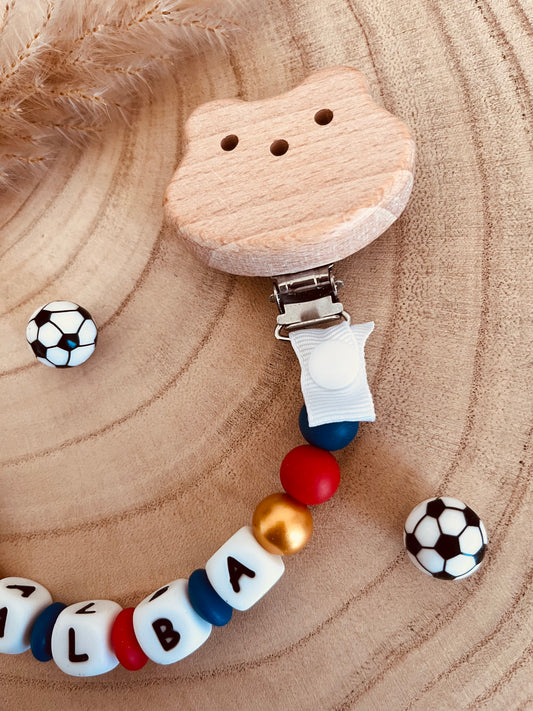
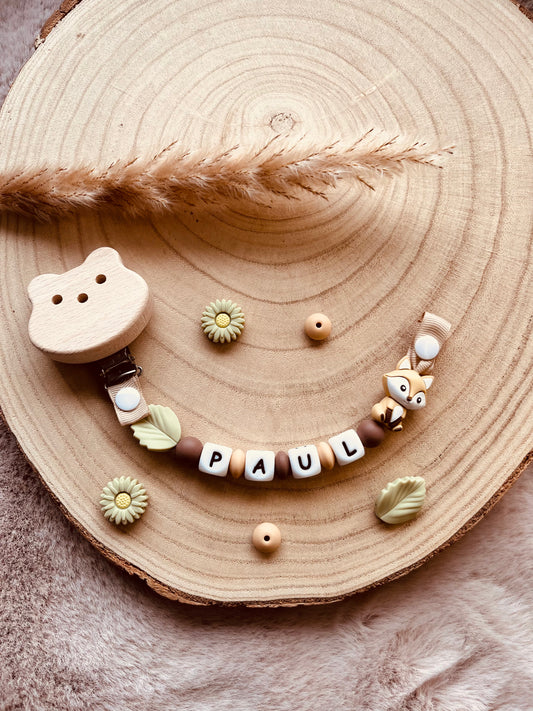
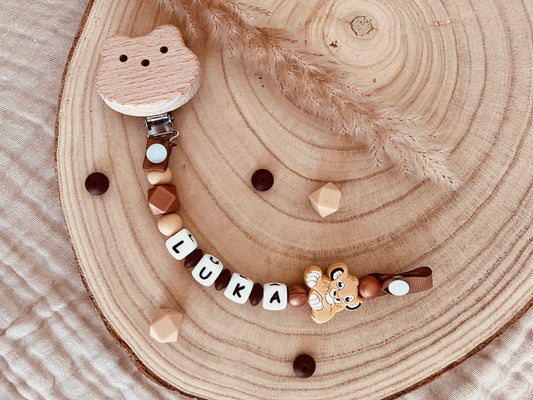
Since this accessory is going to follow your baby everywhere for many months, it may as well be truly theirs. At Babanono, personalisation is done with the first name, spelled out letter by letter in alphabet silicone beads along the clip. It's pretty, it's one of a kind, and — a very practical bonus — it heads off the unhappy mix-ups at nursery or between cousins on the day of a birthday tea: when the name is written right there, there's no doubt about whose it is.
It's also, often, the first little object that's truly "theirs", prepared with real feeling even before the birth. A small detail, perhaps. But a detail that matters, when you've been saying that name aloud for months and you finally see it there on baby's very first dummy clip.
In short
There's no single, magic age. You offer the dummy when your baby needs it — after a few weeks if you're breastfeeding — you add the dummy clip as soon as the outings begin, you keep things safe with accessories that meet the standard and use that's reserved for waking hours, and you turn the page gently between two and three years old. The rest, your baby will whisper to you. They are, after all, the very best guide there is.